

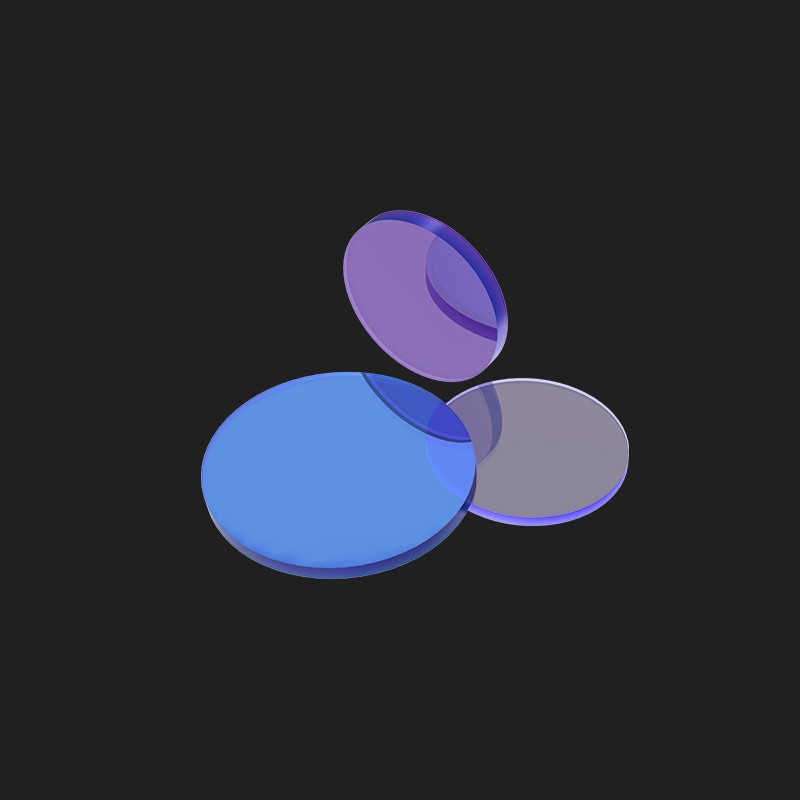

High-precision Visible Windows are crafted from premium optical glass, available in two industry-leading materials: N-BK7 and H-K9L. As precision parallel plane plates, they feature ultra-low optical dispersion, exceptional light transmittance across the visible spectrum (400-700nm), and superior optical uniformity, ensuring minimal light loss and signal distortion during transmission.

Material | Fused Silica, Sapphire, CaF2, ZnS, ZnSe, Si, Ge, etc. |
Dimensional tolerances | +/-0.05, +/-0.1mm |
Surface Flatness | λ/10~1λ |
Parallelism | < 30 arc seconds |
Surface Quality | 10/5,20/10,40/20 |
Edge Chip | <0.1mm |
Bevel | Protective bevel, or based on clients’ requests |
Clear Aperture | >90% |
Coating | According to customer's request |
UV fused silica features a broader spectral transmission range (185 nm – 2.1 μm) than K9 optical glass, with exceptional transmittance in the ultraviolet region. It offers a lower refractive index, higher homogeneity, and a smaller thermal expansion coefficient. Additionally, it exhibits superior chemical resistance and extremely low fluorescence, making it ideal for manufacturing a wide range of precision optical components, including lenses, windows, filters, beam splitters, reflectors, and prisms.
Sapphire windows present outstanding material properties, including high surface hardness, high thermal conductivity, a high dielectric constant, and excellent chemical resistance to acids and alkalis. With a hardness second only to diamond and exceptional structural strength, sapphire windows can be manufactured to thinner dimensions while maintaining high transmittance, compared with standard high-dielectric windows.
Calcium fluoride (CaF₂) delivers an ultra-wide transmission spectrum (180 nm – 8.0 μm), along with a high laser damage threshold, low fluorescence, and excellent uniformity. This material is relatively soft in physical properties, so its surface is susceptible to scratching. CaF₂ windows are widely used for laser collimation applications and serve as a reliable substrate for various optical components such as lenses and windows.
Zinc sulfide (ZnS) is a high-performance optical material designed for infrared applications. It is a chemically inert, yellowish material with excellent refractive index uniformity and consistency. Featuring a broad transmission band (800 nm – 12,000 nm), ZnS windows are widely applied in the production of infrared optical components including infrared windows and lenses.
Zinc selenide (ZnSe) is a widely used infrared optical material with a transmission range of 600 nm – 16 μm. It is characterized by low optical absorption and strong resistance to thermal shock. ZnSe windows are commonly used in thermal imaging systems and selected visible-light optical systems, and can serve as a substrate for lenses, windows, and other precision optical components.
Silicon is a popular optical material for mid-infrared applications, with a transmission band of 1.2 μm – 8.0 μm and high thermal conductivity. It serves as an effective substrate for various optical components including lenses and windows. Silicon windows are widely used in near-infrared and mid-infrared systems, as well as infrared imaging, terahertz imaging, medical, and military applications.
Germanium (Ge) is a widely adopted infrared optical material with a transmission range of 2.0 μm – 16 μm. It features a high refractive index and excellent Knoop hardness. Germanium is chemically inert to air, water, acids, and alkalis, making it suitable for thermal imaging and infrared imaging systems operating in harsh environments.

Phone: +86 189 4674 7897
E-mail: info@aosoptics.com
Whatsapp:8618946747897
Add: Yiju Road High-Tech Zone, Changchun City, Jilin Province, China